init-method方法 init-method方法,初始化bean的时候执行,可以针对某个具体的bean进行配置。init-method需要在applicationContext.xml配置文档中bean的定义里头写明。例如:
1 <bean id ="TestBean" class ="nju.software.xkxt.util.TestBean" init-method ="init" > </bean >
这样,当TestBean在初始化的时候会执行TestBean中定义的init方法。
afterPropertiesSet方法 1 2 3 4 5 6 7 8 9 10 11 12 13 public interface InitializingBean { void afterPropertiesSet () throws Exception; }
afterPropertiesSet方法,初始化bean的时候执行,可以针对某个具体的bean进行配置。afterPropertiesSet 必须实现 InitializingBean接口。实现 InitializingBean接口必须实现afterPropertiesSet方法。
BeanPostProcessor类 BeanPostProcessor,针对所有Spring上下文中所有的bean,可以在配置文档applicationContext.xml中配置一个BeanPostProcessor,然后对所有的bean进行一个初始化之前和之后的代理。BeanPostProcessor接口中有两个方法: postProcessBeforeInitialization和postProcessAfterInitialization。 postProcessBeforeInitialization方法在bean初始化之前执行, postProcessAfterInitialization方法在bean初始化之后执行。
前置后置处理器 Spirng中BeanPostProcessor和InstantiationAwareBeanPostProcessorAdapter两个接口都可以实现对bean前置后置处理的效果,那这次先讲解一下BeanPostProcessor处理器的使用
先看一下BeanPostProcessor接口的源码,它定义了两个方法,一个在bean初始化之前,一个在bean初始化之后
1 2 3 4 5 6 7 8 9 10 11 public interface BeanPostProcessor { @Nullable default Object postProcessBeforeInitialization (Object bean, String beanName) throws BeansException { return bean; } @Nullable default Object postProcessAfterInitialization (Object bean, String beanName) throws BeansException { return bean; } }
下面,我们来实现这个类,测试一下Spring中的前置后置处理器吧
首先是pom.xml,增加Spring相关的依赖
1 2 3 4 5 6 7 8 9 10 11 12 13 14 15 16 17 18 19 20 21 22 23 24 25 26 27 28 29 30 31 32 33 34 35 36 37 38 39 40 41 42 43 44 45 46 47 48 49 50 <project xmlns ="http://maven.apache.org/POM/4.0.0" xmlns:xsi ="http://www.w3.org/2001/XMLSchema-instance" xsi:schemaLocation ="http://maven.apache.org/POM/4.0.0 http://maven.apache.org/xsd/maven-4.0.0.xsd" > <modelVersion > 4.0.0</modelVersion > <groupId > com.myspring</groupId > <artifactId > myspring</artifactId > <version > 0.0.1-SNAPSHOT</version > <packaging > jar</packaging > <name > myspring</name > <url > http://maven.apache.org</url > <properties > <project.build.sourceEncoding > UTF-8</project.build.sourceEncoding > </properties > <dependencies > <dependency > <groupId > junit</groupId > <artifactId > junit</artifactId > <version > 3.8.1</version > <scope > test</scope > </dependency > <dependency > <groupId > org.springframework</groupId > <artifactId > spring-core</artifactId > <version > 5.0.7.RELEASE</version > </dependency > <dependency > <groupId > org.springframework</groupId > <artifactId > spring-beans</artifactId > <version > 5.0.7.RELEASE</version > </dependency > <dependency > <groupId > org.springframework</groupId > <artifactId > spring-context</artifactId > <version > 5.0.7.RELEASE</version > </dependency > <dependency > <groupId > org.springframework</groupId > <artifactId > spring-aop</artifactId > <version > 5.0.7.RELEASE</version > </dependency > </dependencies > </project >
定义一个测试接口:
1 2 3 4 public interface BaseService { String doSomething () ; String eat () ; }
定义接口实现类:
1 2 3 4 5 6 7 8 9 10 public class ISomeService implements BaseService { public String doSomething () { return "Hello i am kxm" ; } public String eat () { return "eat food" ; } }
实现BeanPostProcessor接口
1 2 3 4 5 6 7 8 9 10 11 12 13 14 15 16 17 18 19 20 21 22 23 24 25 26 27 public class MyBeanPostProcessor implements BeanPostProcessor { public Object postProcessBeforeInitialization (Object bean, String beanName) throws BeansException { Class beanClass = bean.getClass(); if (beanClass == ISomeService.class) { System.out.println("bean 对象初始化之前······" ); } return bean; } public Object postProcessAfterInitialization (final Object beanInstance, String beanName) throws BeansException { Class beanClass = beanInstance.getClass(); if (beanClass == ISomeService.class) { Object proxy = Proxy.newProxyInstance(beanInstance.getClass().getClassLoader(),beanInstance.getClass().getInterfaces(), new InvocationHandler () { public Object invoke (Object proxy, Method method, Object[] args) throws Throwable { System.out.println("ISomeService 中的 doSome() 被拦截了···" ); String result = (String) method.invoke(beanInstance, args); return result.toUpperCase(); } }); return proxy; } return beanInstance; } }
Spring的配置文件如下:
1 2 3 4 <bean id ="iSomeService" class ="com.my.spring.beanprocessor.ISomeService" > </bean > <bean class ="com.my.spring.beanprocessor.MyBeanPostProcessor" > </bean >
测试类如下:
1 2 3 4 5 6 7 8 9 10 11 public class TestBeanPostProcessor { public static void main (String[] args) { ApplicationContext factory = new ClassPathXmlApplicationContext ("spring_config.xml" ); BaseService serviceObj = (BaseService) factory.getBean("iSomeService" ); System.out.println(serviceObj.doSomething()); } }
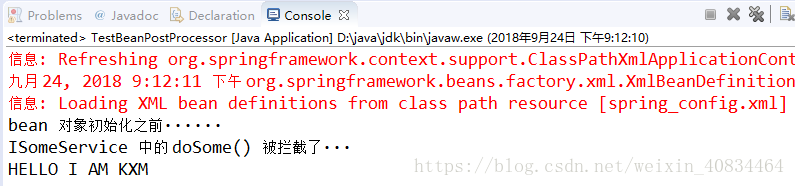
测试结果截图:
可以观察到,我们明明在代码中对于doSomething方法定义的是小写,但是通过后置处理器,拦截了原本的方法,而是通过动态代理的方式把方法的结果进行了一定程度的改变,这就是Spring中的前置后置处理器—-BeanPostProcessor。
总之,afterPropertiesSet 和init-method之间的执行顺序是afterPropertiesSet 先执行,init-method 后执行。从BeanPostProcessor的作用,可以看出最先执行的是postProcessBeforeInitialization,然后afterPropertiesSet,然后是init-method,然后是postProcessAfterInitialization。
参考文章